So What is a Rhododendron
What is a rhododendron? Most people, especially gardeners and visitors to garden centers, have a good idea but their definition is often very limited. For instance, many people do not know that azaleas are in fact rhododendrons. Academically, a rhododendron is a plant that has been classified to be in the genus Rhododendron (within the Ericaceae or heath family). This applies to species plants; natural and human bred hybrids have unique rules to prevent creating new technical classifications.
Species Rhododendrons names are written out as
-
R. "species name in all lower case"
Hybrid Rhododendrons can be written out as
-
R 'Capitalized Hybrid Name' (in single quote)
-
just the hybrid name if context allows
-
showing the parentage (R seed parent x pollen parent)
Follow the Taxonomy link for more details.
For our purposes of the avid gardener, we have
(1) ‘Lepidote’ Rhododendrons
(small scales under the
typically small leafed
or dwarf rhododendrons)
(2) ‘Elepidote’ Rhododendrons
(no scales under the typically
larger leaves but often with
fuzz above or below)
(3) Deciduous Azaleas
(4) Evergreen Azaleas.
Lepidote and Elepidote primarily used toxamonically to separate species into two groups but the typical gardeners just lumps both together as rhododendron.
One last thing here, rhododendrons bloom in what are usually very showy trusses - as few as 2 to or up to 15 or more individual flowers coming out of a given flower bud. It is these trusses that are featured in flower shows.


At The Nursery
What to consider before buying a rhododendron
Rhododendrons can be chosen according to many factors: (1) mature size (dwarf, shrub or small tree), (2) growth rate (size in 10 years), (3) flower truss size, (4) flower color, (5) leaf structure [large/small, fuzzy leaves or not], (6) hardiness and of course (7) leaf color. Remember that a single plant will typically only show blooms for 2 to 3 weeks of the year, so choose plants you like to look at the rest of the year – however with the correct selection of plants in your garden, you can have rhododendron in bloom nearly all year. What you choose will depend on the nature of your individual garden - the space available, sun and wind exposure, topography, soil condition and of course, what is currently available at the nursery.
How To Select Plants Best For Your Enjoyment
Select plants that show no sign of neglect by the retailer; especially inadequate watering, as evidenced by wilting, or by brown edges and tips of leaves. Some issues with a plant may be a condition of being potted (e.g. root bound) or insect damage and can be corrected in the garden with the proper care. Disease is not usually an issue in reputable nurseries.
Many people choose their rhododendrons to provide color coordination within a group or to fit in with other plants in the garden. Others plant based on size coordination and some people just plant willy-nelly. There is no wrong answer if you are happy with the results.
Reading the plant tag
If you go to the nursery in season, you will be able to see what if often the primary criterial for selection: truss shape/size/color and the leaves. However, there is other information available on the plant tag that is useful, especially if you are there out of season. Some plant tags hold a lot of information that the plant collector finds useful and others contain only a bare minimum necessary to enable the gardener to be successful.
The bare minimum will be (1) the plant name, , (2) flower color, (3) mature size of the plant, (4) blooming season and (5) a hardiness rating. Other items of interest might include the formal taxonomy and/or origin of a species, the hybridizer/date/parentage, description of the growth habit, the quality of the flower/plant/performance and ease of growing.
The mature size of the plant is an estimate of the size in 10 years, not the maximum as rhododendrons do not stop growing. Actual growth will be dependent on the garden conditions.
Hardiness is usually given as the lowest USDA hardiness zone that the plant should survive in , all else being equal, or sometimes just list the low temperature that the plant has been observed to survive at. Hardiness is not just a function of the temperature on the news; sun and wind exposure, ground moisture both in summer and winter, and other factors can impact the micro-climate in your garden. But there are actions the gardener can take to mitigate a cold snap such as covering the plant (leave the snow on the leaves until it warms up) or using Christmas lights to provide a little warmth during the coldest times.
Flowering time can vary significantly from season to season and within micro-climates. However, general bloom times will be listed as a calendar month or a blooming season:
VE = January to March 15
E = March 15 to April 15
EM = April 15 to May 1
M = May 1 to June 1
L = June 1 to June 15
VL = June 15 to August or later
When in doubt about a particular tag, feel free to ask the nurseryman for details.
YOUR RHODY AT HOME
When to Plant
Rhododendrons and azaleas are best planted in early fall or spring, but can be planted nearly year round with extra care. Spring is when most of the rhododendrons are in full bloom and you bring them home – keeping the well hydrated during the summer is a must until become established. Fall is a good time plant as mother-nature will provide the moisture while the plants become established during the winter. But, keeping the nursery plant in a pot during the summer is sometimes a challenge, especially if the plant is root-bound.
Where to Plant
All rhododendrons and azaleas grow best in a porous, moist, well drained, acidic soil, high in organic matter. If you are creating a garden out a NW forest, this should not be a problem, but if you are in a development where all the top soil was removed or fill dirt brought in, amending the planting area may be necessary.
Large-leaf rhododendrons and evergreen azaleas generally prefer a site protected from drying winds and hot summer sun. Small–leaf rhododendrons and deciduous azaleas tend to be tolerant of more exposed planting sites. Seek specific advice from nursery experts or ARS members in your area. In choosing a site, consider plant growth rate, and mature size. Avoid planting in dry soils, too close to the foundation, under roof overhands or under trees with aggressive and thirsty root systems (e.g. Western Red Cedar) or dense shade.
Rhododendrons can also be planted in pots when the soil conditions are too extreme or when hardiness is an issue and there is the opportunity to move the plant to a protected area. NOTE: there are to extra concerns using pots – the pots will dry out much quicker and the roots are exposed to lower temperatures than when the plant is planted in the ground.
Soil and plant preparationgraph
Dig the planting hole wider, but no deeper, than the root system of your plant. If your soil is poor quality, mix in peat moss, and/or fine pine bark, and good loam to the soil excavated from the hole (but limit organic matter to 25% to enable roots to quickly re-establish in the ground). If soil is poorly drained, plant in a raised bed or a berm.
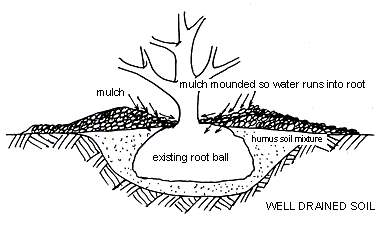
For plants in pots and burlap: Remove the container or root wrapping material from your plant. Expose the root ends an inch (2.5 cm) or more by abrading with your fingers or a scratcher, or by washing with water before setting the plant in the hole.
Backfilling
The top of the root system should be slightly above, but no lower than, the final ground level. Hold extended root ends up and gently pack the soil around the roots, and form a saucer near the outer edge of the hole to hold water to irrigate the roots. Shaking the plant while backfilling will help the soil filter down into the root zone, help to keep the root ball high and minimize settling of the plant.
Mulching
Add 2 to 3 inches (5 to 7.5 cm) of bark mulch or other porous material to help control weed germination, conserve moisture, and hold the soil. Avoid covering the root crown at the base of the plant.
Watering-in
As soon as you finish backfilling and mulching, add enough water to thoroughly soak the soil and root system. This helps pack the soil around the roots and assure rapid root growth into the surrounding ground.
MAINTENANCE IN THE GARDEN
Watering
During the first year, add water once or twice a week to avoid drying the roots and ensure proper establishment of the roots. Thereafter, water only as soil conditions require. Soil should not stay wet.
Mulching
Maintain 2 to 3 inches of mulch.
Fertilizing
Most rhododendrons and azaleas require very little fertilizing. See advice from experts in your area.
Deadheading
Twisting off faded flower heads soon after blooming enhances bud-set the following year, enhances the appearance of the non-blooming plant but is not necessary for the health of the plant - rhododendrons in the wild do not get deadheaded. Be careful not to damage vegetative growth shoots.
Pests and diseases
Healthy and vigorous plants tend to have few pest problems. But rhododendrons and azaleas can be susceptible to root weevil and leaf chewing insects as well as root disease problems. Consult with experts in your area for advice.
Pruning
Properly sited rhododendrons and azaleas need minimal maintenance. If branches must be trimmed, this is best done right after flowering to enable the best regrowth and flowering the following year. However, minimum pruning can be accomplished anytimg of the year. It is best to prune to a branch.
Choosing a Plant
In the Pacific NorthWest, there are relatively few rhododendrons that we cannot grow, but if you get one by accident, the loss can be very upsetting. Most of the issues revolve around temperature hardiness. We cannot grow Vireyas anywhere outdoors in the winter as they cannot tolerate sub-freezing temperatures: the same with many of the large leaf species which are also not very hardy - they might survive one mild winter and then die the next. However, most of these will not be carried at a local nursery. The issue will normally be with plants purchased out of the area, like Northern California or the Oregon coast where the conditions are different.
However, the situation is a little different with hybrids. The parent ancestry often contains non-hardy plants but have been bred to tolerate lower temperatures. It is not uncommon to see plants with a hardiness rating of +5 or even +15. These will be marginal in most of our gardens. Hardiness to 0 degrees or below should produce a plant that will do well or even thrive in your garden. Thus, know your hardiness zone ( ), but remember geography can cause micro-climates to mess things us - e.g.wind exposure and humidity.
The Following are Proven Winners
these should be available locally
Taurus
early bloomer
red
large to very large
R degronianum ssp. yakushimanum [R yakushimanum]
mid season bloomer
pink
medium size
R rex
mid season bloomer when mature
white
medium to large
Seaview Sunset
early bloomer
yellow/coral
small
Unique
mid season bloomer
cream colored
medium to large
Blue Baron
early bloomer
blue
semi dwarf
Blue Tit {R augustinii cross}
early bloomer
light blue
small
Christmas Cheer
very early bloomer
pink
medium


For information on other species and hybrids,
the following web sites are a good resource.
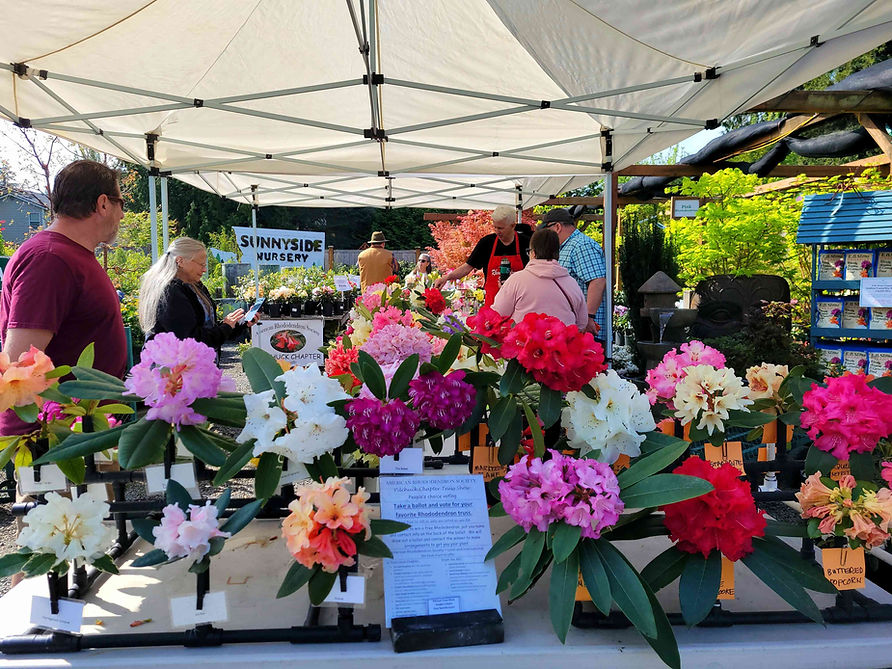
Truss show winners
Year | Location | First Place | Votes | Second Place | Votes | Third Place | Votes | Total Votes |
|---|---|---|---|---|---|---|---|---|
2026 | Flower World | Paprika Spiced | 9 | Cranberry Lace | 6 | Honey Butter | 6 | 61 |
2026 | Sunnyside Nursery | Cloud Burst/Ink Spot | 4 | Busty Trusses/Pres Rooseveldt/Sue Ann/R. turacao | 3 | 28 | ||
2024 | Flower World | Kathy Harper | 4 | Mavis Davis | 4 | Shogun | 4 | 44 |
2024 | Sunnyside Nursery | Cherries & Cream | 4 | GW Leak | 4 | Honey Butter | 3 | 40 |
Semi Technical Classification
In the history of botany, plant hunters sought to identify and classify the different plants that they encountered. Taxonomy is the study of naming plants and was originally quite arbitrary. The plants were classified by inspection: the differences at times striking and at other times requiring microscopic inspection to determine the differences. Then sometimes, one attribute is nearly identical while another is very different. This leads to disagreement between ‘experts’ as to where to place that plant. Even today, this plays havoc with hobbyist collectors as the official name of a plant is changed: For instance, species Rhododendron yakushimanum is now classified as R. degronianum ssp. Yakushimanum.
For the genus rhododendron, there are eight sub-genera, but this has been challenged (proposal in 2004 to change to only five sub-genera) based on chemical and genetic data. And then the sub-genera have sections and sub-species.
For more technical details: